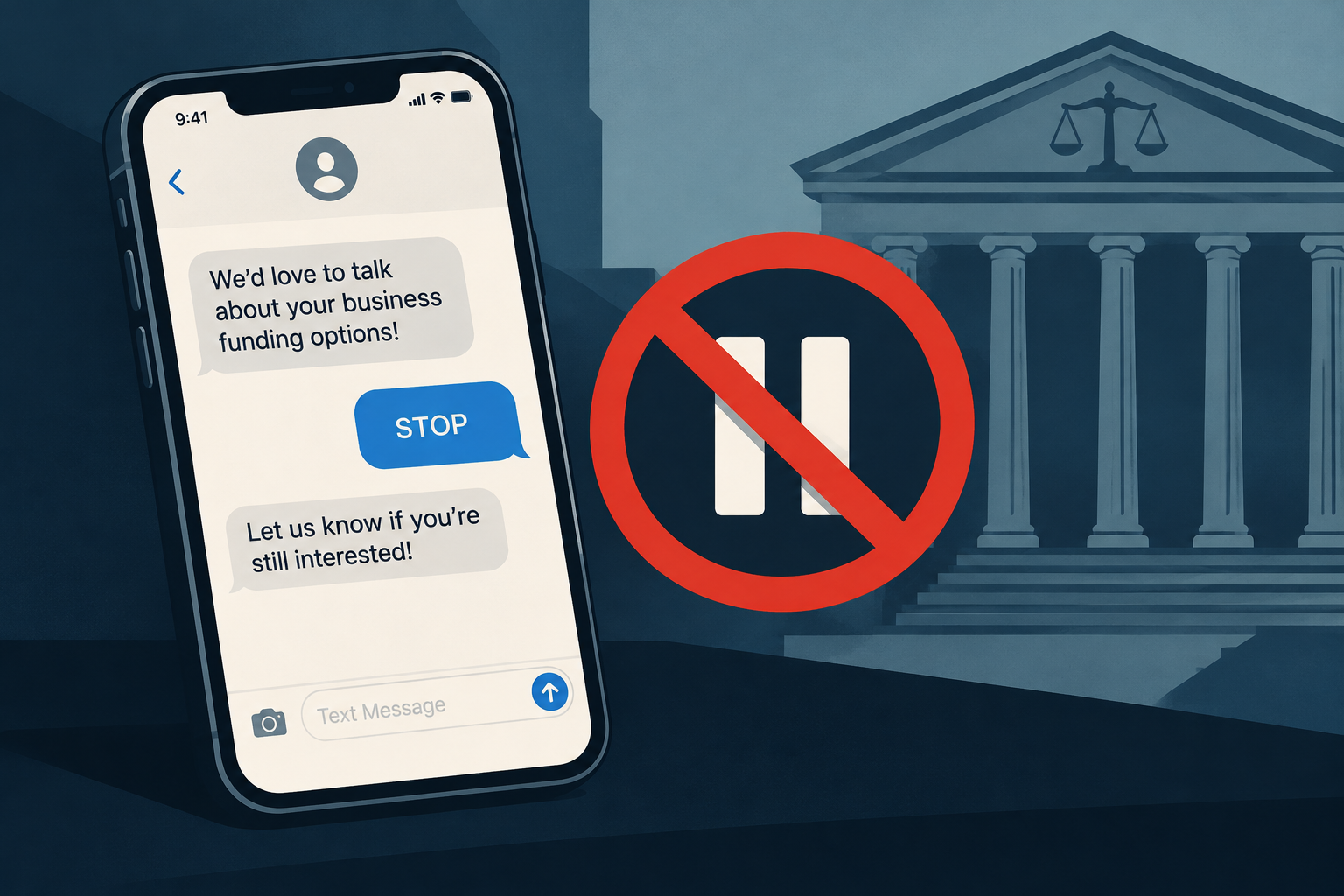
Ever since the Seventh Circuit held in Steidinger v. Blackstone Medical Services, 182 F.4th 532 (7th Cir. 2026), that a text message isn’t a “call” under the TCPA, defendants have been bringing that opinion into every courtroom that will let them in. A federal court in Houston just read it, mostly agreed with it, and ruled against it anyway.
The ruling came in Taylor v. Offerspdq, LLC, No. 4:23-cv-3018, 2026 U.S. Dist. LEXIS 232851 (S.D. Tex. Sept. 30, 2026). It addressed a stack of TCPA default judgment motions against a group of telemarketers, several of them identified in the caption only by the phone numbers they called from. Six of those defendants had only ever texted the plaintiff, so the Court had to decide whether a text can support a claim under § 227(b)(1)(A)(iii).
Here’s the twist. On plain language, the Court sided with Steidinger. The TCPA statute “proscribes telemarketing calls, not text messages,” it wrote. And in 1991, nobody “would have understood the term ‘call’ to capture a not-yet-invented non-auditory form of textual communication.”
Then it hit the brakes. In Campbell-Ewald Co. v. Gomez, 577 U.S. 153, 156 (2016), the Supreme Court said “[a] text message to a cellular telephone, it is undisputed, qualifies as a ‘call’ within the compass of § 227(b)(1)(A)(iii).” District courts don’t get to overrule that sentence just because they would have written it differently.
Steidinger reads a footnote in a later TCPA Supreme Court case, Facebook, Inc. v. Duguid, 592 U.S. 395, 400 n.2 (2021), as proof that Campbell-Ewald was just an assumption. The Court rejected that reading too. A footnote describing what the Duguid parties didn’t dispute “does not controvert the seemingly authoritative statement” in Campbell-Ewald, and the Court was “unwilling to read as mere dicta the Supreme Court’s plain statement on this issue.”
So, “[u]nless and until the Supreme Court definitively revisits its conclusion in Campbell-Ewald,” and with no word from the Fifth Circuit, people who receive telemarketing texts have a private right of action under § 227(b). The defendants who only texted got judgments entered against them.
This decision shows that the way around Steidinger runs straight through the Supreme Court’s own words.
One caveat. The holding is tied to § 227(b), the provision Campbell-Ewald named, because that’s the only TCPA relief the plaintiff sought. Whether the same logic carries over to § 227(c)(5)’s “telephone call” is a fight for another day.
Meanwhile, Texas settled this question in its own statute. The Texas telemarketing statute bars a seller from making even a single “telephone solicitation” without a state registration certificate. And it defines “telephone solicitation” to include “a transmission of a text or graphic message.” No 1991 dictionaries required.
Texas also puts real money behind it. Section 302.302(a) carries statutory penalties that came to $5,000 per message in this case, ten times the TCPA’s $500. Section 302.302(d) adds “all reasonable costs of prosecuting the action.”
Even statutory damages are bigger in Texas.