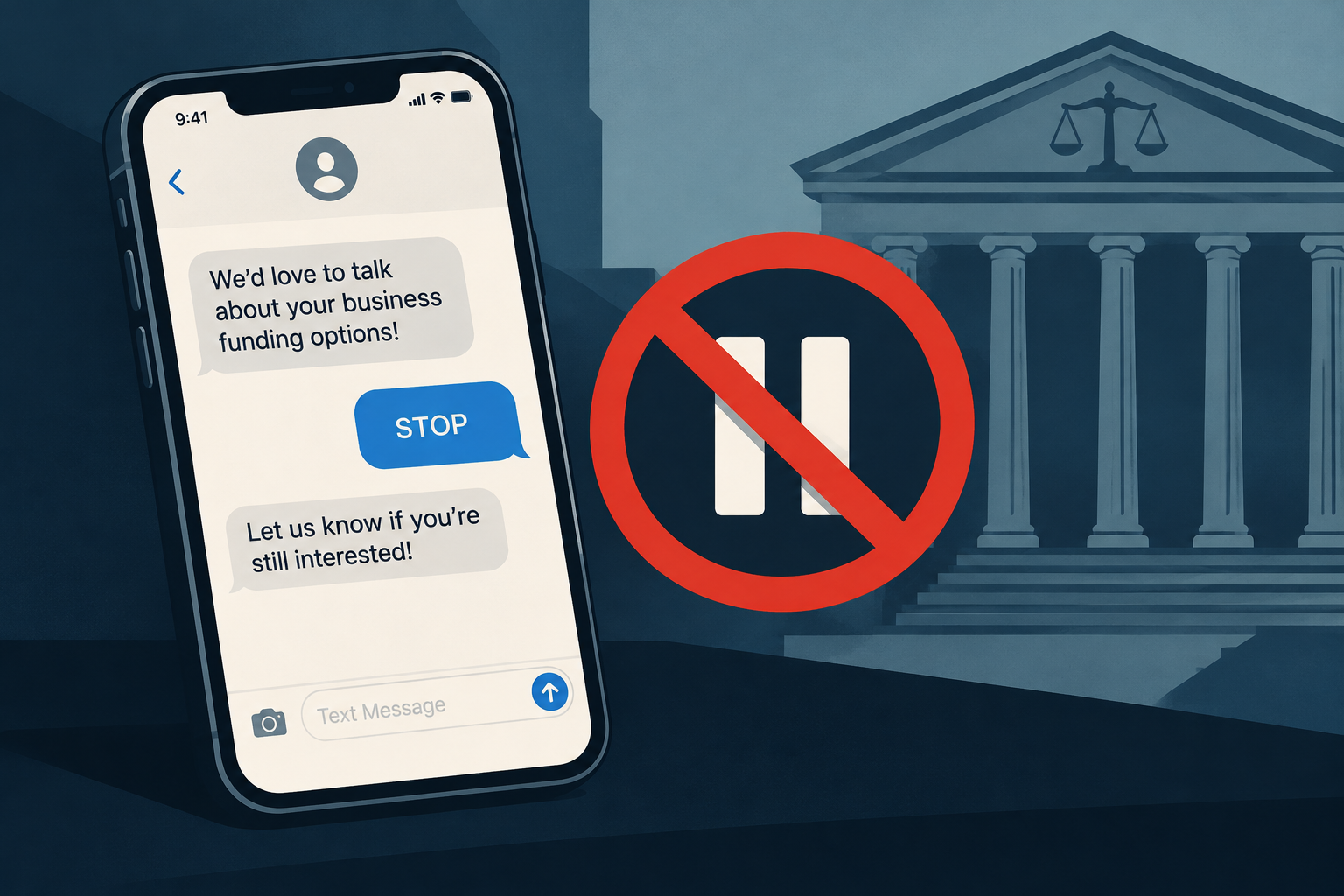
Telemarketers who get sued under the TCPA over text messages have a favorite argument these days: a text is not a “call,” so the Do Not Call rules don’t apply. A newer move is to use that argument twice, once to seek dismissal and again to ask the court to freeze the whole case in the meantime.
That second move did not work in Bachhuber v. Secure Investing Advisors, LLC, No. 26-CV-03502 (S.D.N.Y. Oct. 7, 2026).
The defendant had moved to dismiss, arguing that Section 227(c)(5) does not reach text messages. It then asked the Court to stay discovery until that motion was decided or, failing that, to split discovery into phases. Its pitch was that the “overwhelming consensus” outside the Second Circuit is on its side.
The Court was not persuaded. It found the defendant “has not made a strong showing that Plaintiff’s claims are unmeritorious.” The reason was close to home. As the Court put it, “at least one court in this District recently addressed the issue and held otherwise,” citing Wilson v. Better Mortgage Corp., 2025 WL 3493815 (S.D.N.Y. Dec. 5, 2025), which concluded at the motion to dismiss stage that Section 227(c)(5) applies to text messages.
On the other side of the coin, the Court found real harm in waiting. An indefinite stay “would prejudice Plaintiff, as it would hinder Plaintiff’s ability to obtain evidence to support his claims.”
The backup request to bifurcate went nowhere too. “Bifurcation in this Circuit is the exception,” the Court wrote, and splitting things up here “would result in inefficiencies and obfuscate the issue of what discovery relates to the class as opposed to the named plaintiff.”
The motion to dismiss is still pending, so the texts-versus-calls question in this case has not been answered. But the defendant asked for a timeout and a smaller playing field, and got neither.