
A TCPA defendant in the Northern District of California just learned that if you want a click to function as an agreement, the button has to say so.
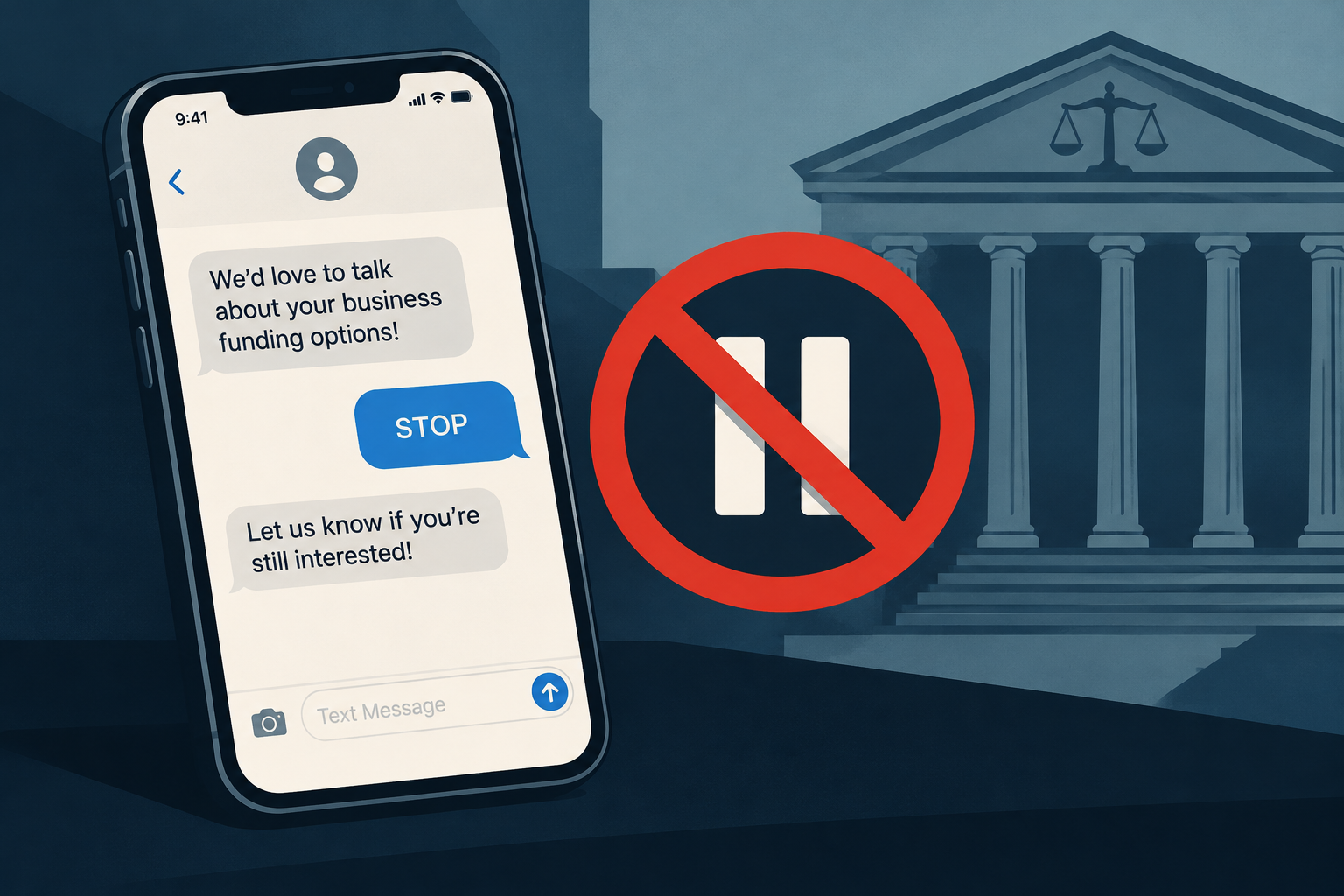
In Wong v. LaserAway, LLC, 2026 U.S. Dist. LEXIS 157356 (N.D. Cal. July 15, 2026), the plaintiff filled out a questionnaire on the LaserAway's website — an aesthetics company selling laser hair removal, injectables, and the like — and provided her phone number. She alleges LaserAway then kept sending her marketing texts after she told them to stop in violation of the TCPA. LaserAway moved to compel arbitration, pointing to the Terms and Conditions hyperlinked on its website form. Its theory of how she agreed to them: she clicked a button labeled "GET MORE INFO."
The Court laid out the framework. Under California law there "must be actual or constructive notice of the agreement and the parties must manifest mutual assent." Oberstein v. Live Nation Ent., Inc., 60 F.4th 505, 512-13 (9th Cir. 2023). Online contracts run on a spectrum from clickwrap — a pop-up with an "I agree" box — to browsewrap, where terms hide behind a hyperlink and mere use of the site supposedly binds you. Keebaugh v. Warner Bros. Ent. Inc., 100 F.4th 1005, 1014 (9th Cir. 2024).
This one landed in the middle, as a modified clickwrap, which is enforceable only if the site gives "reasonably conspicuous notice of the terms to which the consumer will be bound" and "the consumer takes some action, such as clicking a button or checking a box, that unambiguously manifests" assent to the terms. Kroskey v. Elevate Labs, LLC, 2025 WL 1507091 (N.D. Cal. May 27, 2025) (citing Berman v. Freedom Fin. Network, LLC, 30 F.4th 849, 856 (9th Cir. 2022)).
On the "actual or constructive" notice prong the plaintiff claimed the font was too small and the "terms and conditions" hyperlink wasn't set off in a contrasting color that stood out. The Court opined that the overall design of the form "may have been sufficient" and assumed actual or constructive notice for the sake of argument.
That's usually not a great sign if you're opposing the terms. The next part of the analysis is where this order really stands out.
Berman requires that "[a] user's click of a button can be construed as an unambiguous manifestation of assent only if the user is explicitly advised that the act of clicking will constitute assent to the terms and conditions of an agreement." 30 F.4th at 857. The notice "must explicitly notify a user of the legal significance of the action she must take." Id. at 858. With that standard in mind, the Court wrote:
"Inviting the users to 'get more info'could reasonably be construed as an offer to provide additional information about LaserAway's products and services prior to forming any agreement. Indeed, the button might even be understood as a means for obtaining details of the 'terms and conditions' prior to assenting to them. In any event, a button labeled 'get more info' falls short of explicitly advising users that the act of clicking it will constitute assent to terms and conditions available through a hyperlink elsewhere on the page."
So not only does "get more info" fail to signal agreement — it plausibly signals the opposite, that the user is about to read the terms rather than accept them.
The Court then denied LaserAway's motion to compel arbitration. The button was built to sound like nothing at all, and the Court took it at its word.
This is a great win for consumers here and it's encouraging to see a court decline to find an agreement to arbitrate where nobody made one.