
Why are TCPA defendants still making this argument in the 9th Circuit?
In the Western District of Washington, a home-selling referral company just learned that "a text isn't a call" is a losing argument—at least anywhere the Ninth Circuit's word is law. The order in Hopkins v. HomeLight, Inc., No. 26-cv-5017-BHS (W.D. Wash. July 13, 2026), denied the defendant's motion to dismiss and, along the way, treated one of the defense bar's favorite arguments as effectively settled.
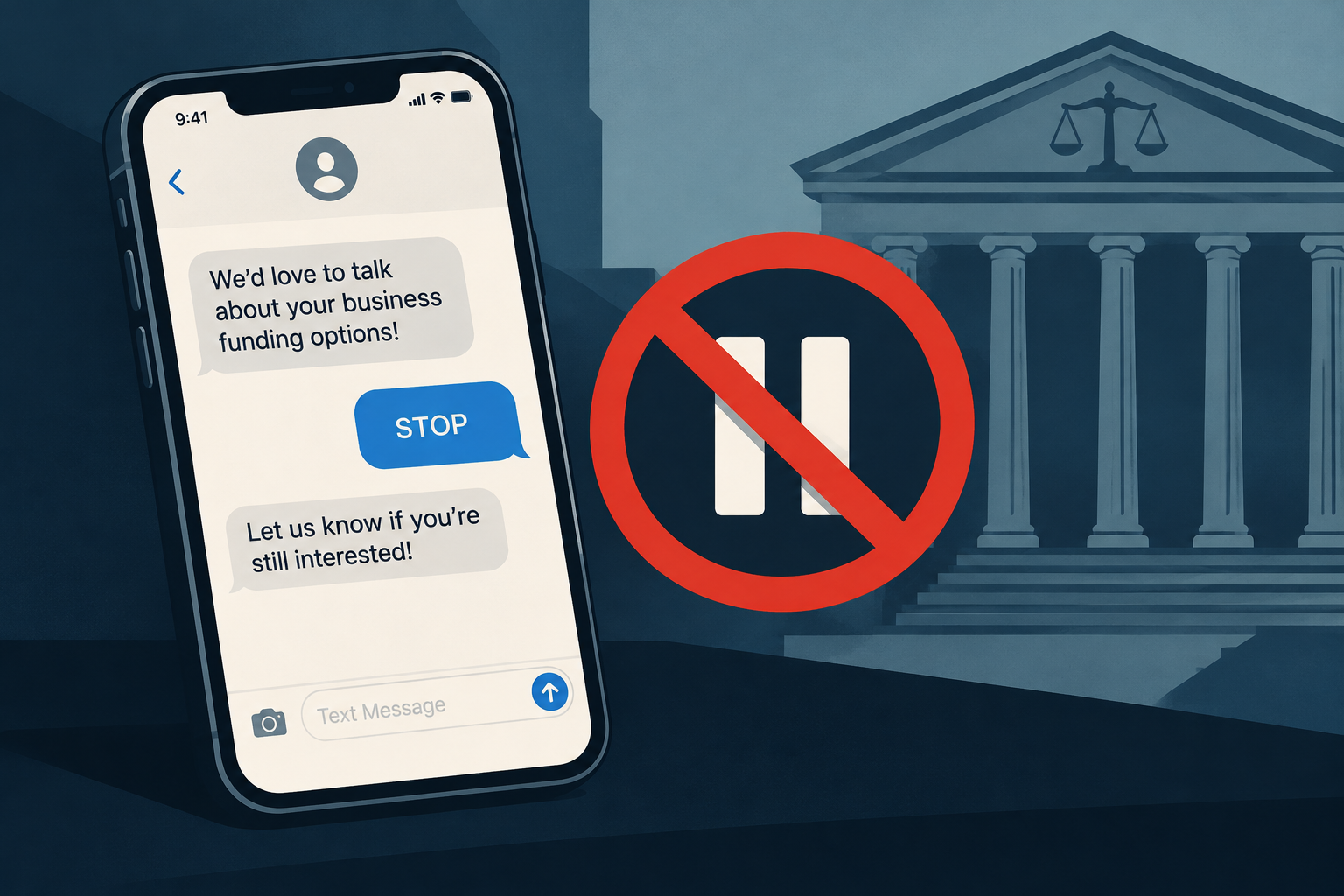
The facts are the kind you've seen before. The plaintiff got a call offering to connect him with a real estate agent to sell his home. He asked the caller to stop. It called three more times that day and twice the next. Then the texts started—thanking him for his "interest," offering agent recommendations, and continuing to arrive even after he wrote back "please stop all communication" and received an unsubscribe confirmation. The messages did not fully stop for more than a month. He sued under the Do-Not-Call provisions of § 227(c).
The defendant's headline argument was that § 227(c) covers only a "telephone call," and that a text message is not one. The Court disagreed, and it did not treat the question as close. Binding Ninth Circuit precedent, it explained, already resolves it. In Satterfield v. Simon & Schuster, Inc., 569 F.3d 946 (9th Cir. 2009), the court acknowledged that "call" was ambiguous—texting did not exist when the TCPA was enacted in 1991—but found that both the ordinary meaning of the word and the statute's privacy purpose pointed the same way.
"Call," the court noted, means "to communicate with or try to get into communication with a person by a telephone." A text does exactly that.
The defendant tried to cabin Satterfield and its recent successor, Howard v. Republican Nat'l Comm., 164 F.4th 1119 (9th Cir. 2026), to § 227(b). That did not work either.
Howard is worth noting because it confirmed, even after Loper Bright ended Chevron deference and on de novo review, that "a 'text message' constitutes a 'call' within the meaning of the TCPA." The Court here saw no reason the same logic would stop at § 227(c). It rejected the idea that "call" changes meaning because it appears as a noun in § 227(c) rather than as a verb in § 227(b):
"There is no difference in the meaning of 'to make a call' or 'to receive a telephone call.'" It added that the 2024 FCC rulemaking explicitly extended DNC protections to texts, and that the district courts urging the opposite were all outside the Circuit, while in-circuit courts have lined up the other way.
The Court also brushed aside the "we didn't sell you anything" defense. A message can be a solicitation if its purpose is to steer a consumer toward a purchase—including a referral that earns the sender a fee. That the texts "did not try to sell him anything on their face" did not save them where the whole point was to match him with a paid broker.
Finally, on the internal-DNC claim, the Court found it enough that the defendant kept contacting the plaintiff more than ten days after his repeated requests to stop. Citing Gulden v. Quicken Loans Inc., it held that a caller without procedures in place before the call can be liable, and that a plaintiff need not allege he asked for a copy of the internal policy to survive a motion to dismiss. The defendant's "just responding to an inquiry" story didn't explain why the messages kept coming after beign asked to stop.
For anyone still hoping the post-Chevron world would reopen the "text isn't a call" question under § 227(c), the door in the West looks firmly shut to that argument.